
How to Tell if a Mango Was Ripened with Carbide — 5 Home Tests

Abhilash Kasliwal

Table of Contents
- What calcium carbide is and why traders use it
- Why carbide fruit looks ripe but tastes flat
- How do you identify mango fruit ripened with calcium carbide or other chemicals?
- Test 1 — the water test, with an honest note
- Test 2 — the colour pattern
- Test 3 — the smell at the stem
- Test 4 — the cut test
- Test 5 — taste and juice
- Does washing and peeling remove the toxic effects?
- How we ripen at Kasliwal Farms instead
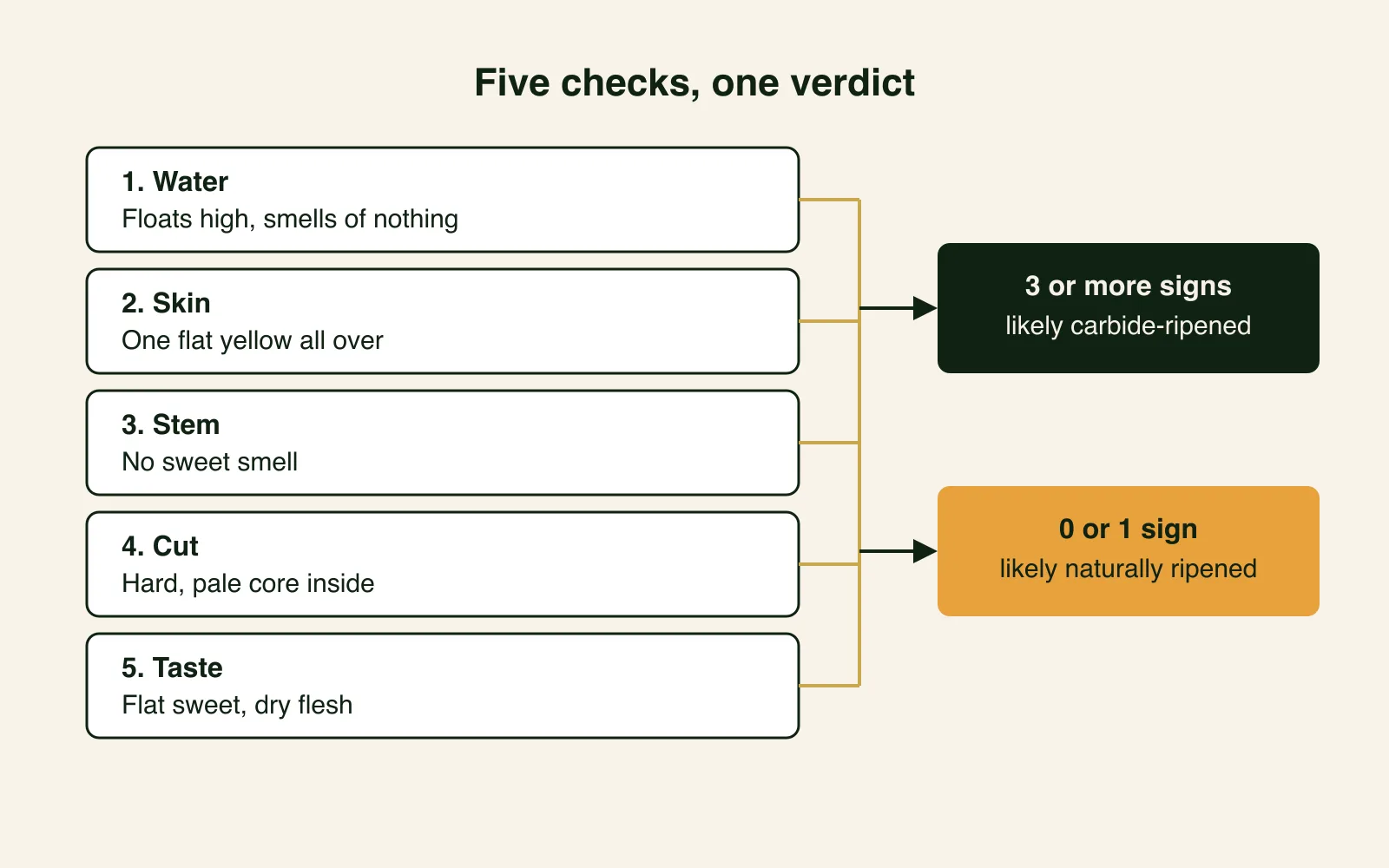
A carbide-ripened mango usually gives itself away in three places: skin that is one flat, even yellow with no green patches, a stem end that smells of nothing, and a hard, pale core under ripe-looking skin. No single home test is conclusive — the famous water test least of all — but a mango that fails three or more of the five checks below was very likely ripened with chemicals rather than time. This guide explains how to run each test, what it can and cannot prove, and why the differences exist in the first place.
What calcium carbide is and why traders use it
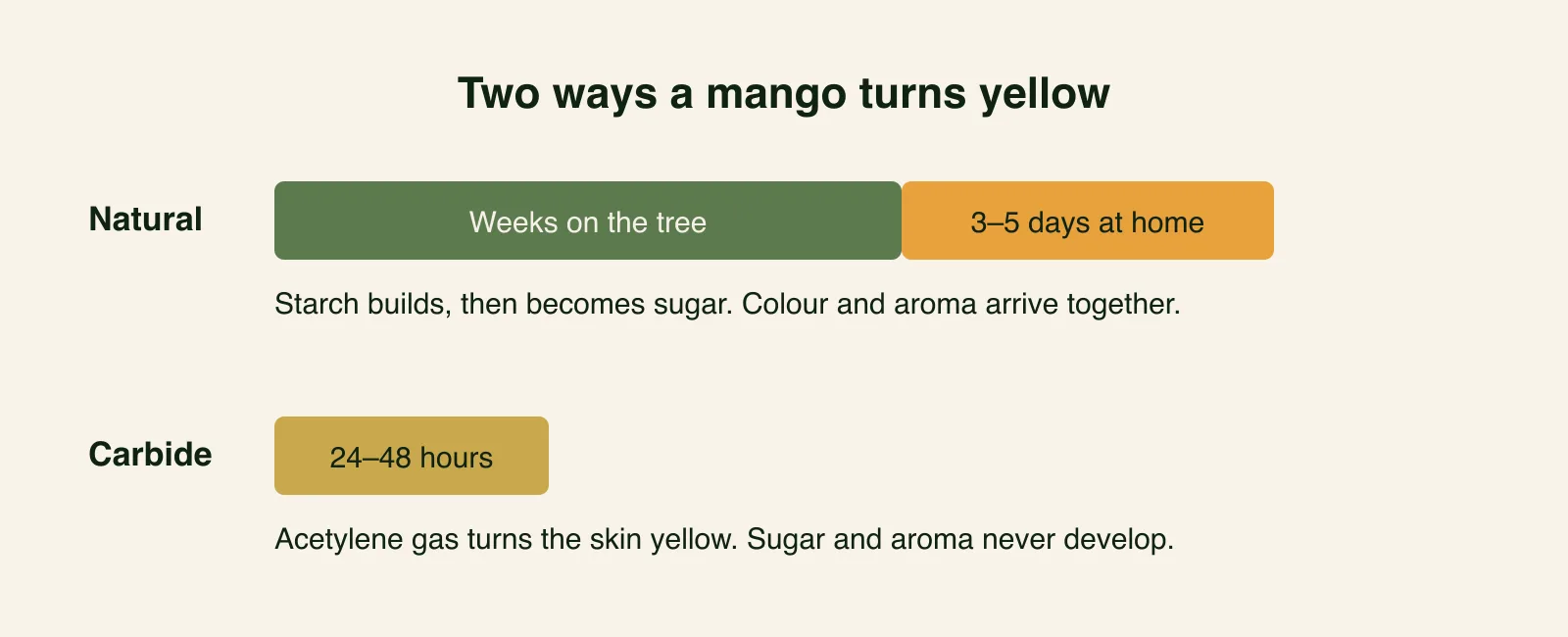
Calcium carbide is an industrial chemical, best known as the raw material for welding gas. When it meets moisture it releases acetylene, a gas that imitates ethylene — the hormone a mango produces on its own when it ripens. Put a small sachet of carbide in a crate of green mangoes, and within 24 to 48 hours every fruit in the crate turns an even, saleable yellow.
The commercial logic is simple. Mangoes picked early are hard, so they survive rough transport and sit longer on a shelf. Carbide then colours them ripe on a schedule the trader controls, and the whole crate turns on the same day — which suits a wholesale buyer and tells you nothing about whether the fruit inside is ready.
India banned the practice. FSSAI regulations prohibit selling fruit ripened with calcium carbide, partly because industrial-grade carbide often carries traces of arsenic and phosphorus compounds. FSSAI does permit ripening with ethylene gas up to 100 parts per million, which is a controlled version of what the fruit does anyway — so "artificially ripened" is not automatically a scandal. Carbide specifically is the problem, and it persists because enforcement at the mandi level is thin.
Why carbide fruit looks ripe but tastes flat
Ripening is two separate processes that normally run together. One changes the outside: chlorophyll in the skin breaks down and the yellow-orange pigments underneath show through. The other changes the inside: starch converts to sugar, enzymes soften the flesh, and the volatile compounds that make a mango smell like a mango are produced late in the sequence.
Acetylene triggers the first process on demand. It cannot run the second, because a mango picked too early never built up the starch that ripening would have converted to sugar. There is nothing to convert. The result is fruit that looks finished outside and stayed unfinished inside — and every home test below works by catching that gap.
How do you identify mango fruit ripened with calcium carbide or other chemicals?
Run the five checks in order. The first three need nothing but the fruit in your hand; the last two cost you one mango.
Test 1 — the water test, with an honest note
Fill a bucket and drop the mango in. A naturally ripened mango has dense, sugar-heavy flesh and tends to sink or hover low. A carbide-ripened one was usually picked immature, with an underdeveloped interior, and tends to float high.
The honest note: this test is a screen, no more. Density also varies with variety, seed size, fibre and how ripe the fruit is, so natural fruit sometimes floats and treated fruit sometimes sinks. No food-safety authority endorses the float test as proof. Use it to decide which mangoes deserve closer inspection, and give it one vote out of five.
Test 2 — the colour pattern
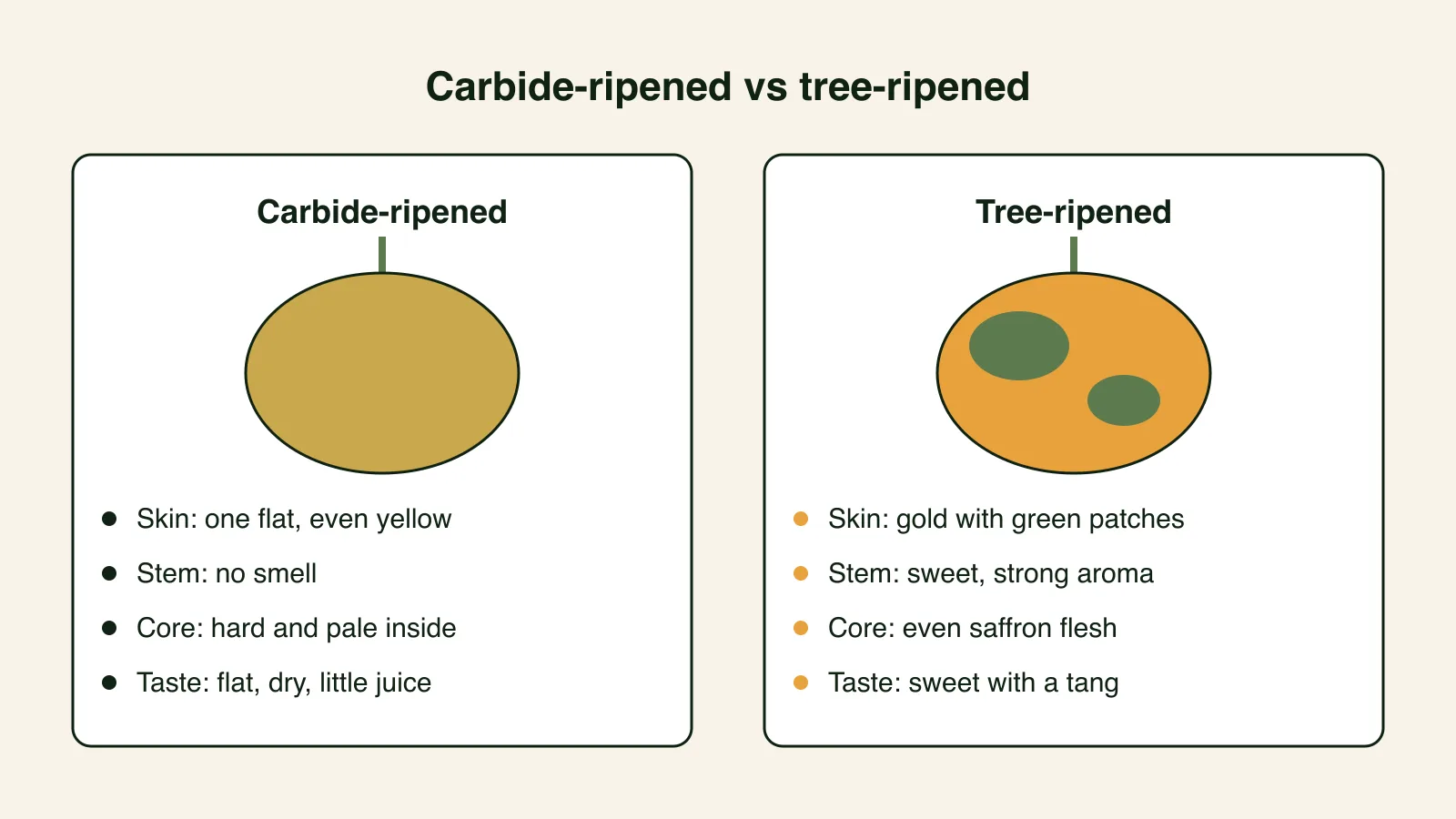
Nature ripens a mango unevenly. The sun-facing side colours first, so a naturally ripened Kesar shows gold shading into green, patch by patch — and a fully ripe Kesar can still carry green on its skin. Carbide produces the opposite: one flat yellow from stem to tip, sometimes with a faint powdery residue near the stem. At a shop, forty identical mangoes in the same shade of yellow on the same day is itself the strongest colour signal you will get.
Test 3 — the smell at the stem
Aroma compounds are made in the last stage of true ripening, which is exactly the stage carbide fruit never reaches. Hold the stem end to your nose. A ripe mango announces itself — sweet, slightly resinous, unmistakable. Carbide fruit smells of very little, occasionally of something faintly sharp. This is the test worth learning well, because it needs no bucket and no knife and it is hard to fake.
Test 4 — the cut test
Slice one open. Ripening forced from outside leaves a record in the flesh: yellow near the skin, then progressively paler toward a hard, greenish-white core around the seed. A tree-matured, naturally ripened Kesar is even in colour from skin to seed — a consistent saffron-orange. Ripe-looking skin over a hard, sour centre is as close to proof as a home test gets.
Test 5 — taste and juice
Carbide fruit eats dry. The sweetness is faint and one-note, the tang that balances a good Kesar is missing, and there is noticeably little juice. Some people also report a mild burning or tingling at the lips and throat. If a mango looked perfect and still disappointed you, this is usually the reason.
Does washing and peeling remove the toxic effects?
This is one of the most-asked mango questions on Quora, and it deserves a straight answer: partially. Washing removes powder residue that may sit on the skin, and peeling discards the surface a gas treatment touched most, so a washed and peeled carbide mango carries less risk than an unwashed one. Wash every mango you buy regardless of its source — ours included.
What washing cannot do is fix the fruit. The missing sugar, the missing aroma and the hard core are development that never happened inside the flesh, and no amount of water reaches that. You can make a carbide mango cleaner. Nothing makes it good.
How we ripen at Kasliwal Farms instead
We grow only Kesar, in Marathwada, and we ripen it the old way: the fruit stays on the tree until it reaches full maturity, is harvested in batches, and finishes at ambient room temperature — certified organic, with zero carbide involved at any stage. The slowness shows up in the logistics, and we think that is a feature: your box ships slightly firm and completes its ripening on your counter in two to four days. Our guide to ripening a Kesar box at home walks through those days one by one.
The five tests above are how you audit any seller after the box arrives, and we would rather be audited than trusted blindly. If you are still deciding whom to order from, our checklist for buying mangoes online safely covers the questions to ask before you pay.
FAQ
Questions readers often ask
Keep Reading
More stories from the orchard

Kesar vs Alphonso — Which Mango Should You Buy?
Both are elite mangoes. Alphonso brings buttery dessert richness at ₹1,000-plus per kg online; Kesar brings saffron aroma and a sweet-tang balance at a third of the price. Here is how to choose.
Abhilash Kasliwal
6 min read

How to Ripen Kesar Mangoes at Home — A Day-by-Day Guide
Firm Kesar mangoes ripen on the counter in 2–4 days. When the rice jar helps, when the fridge ruins fruit, and how to tell a Kesar is ready by smell, give and colour.
Abhilash Kasliwal
6 min read

Is It Safe to Order Mangoes Online in India? A Farmer's Honest Checklist
Yes, if you check five things before paying. A farmer's checklist for spotting honest mango sellers — named farms, firm-fruit honesty, stated weights, a real damage policy and season discipline.
Abhilash Kasliwal
6 min read