
How to Ripen Kesar Mangoes at Home — A Day-by-Day Guide

Abhilash Kasliwal

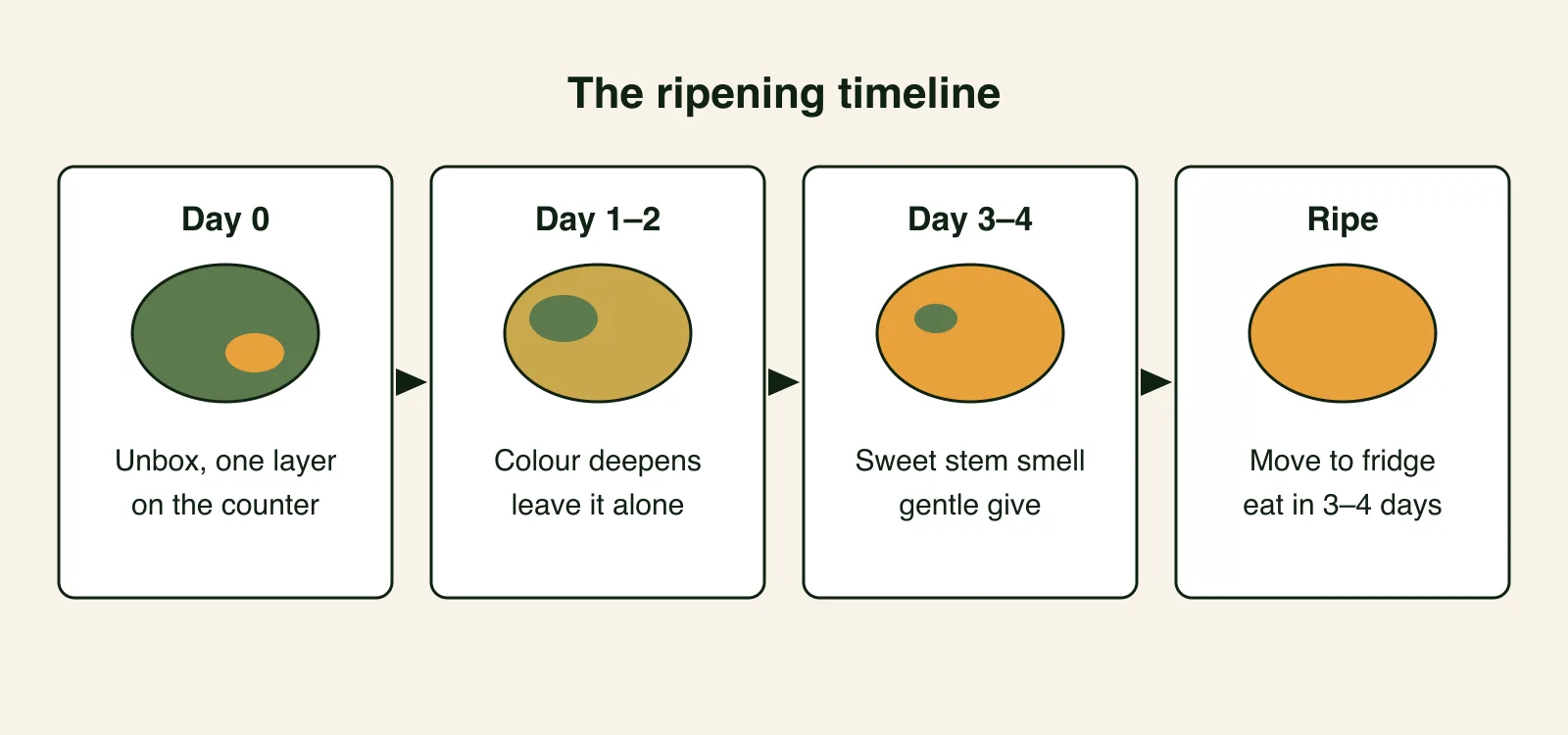
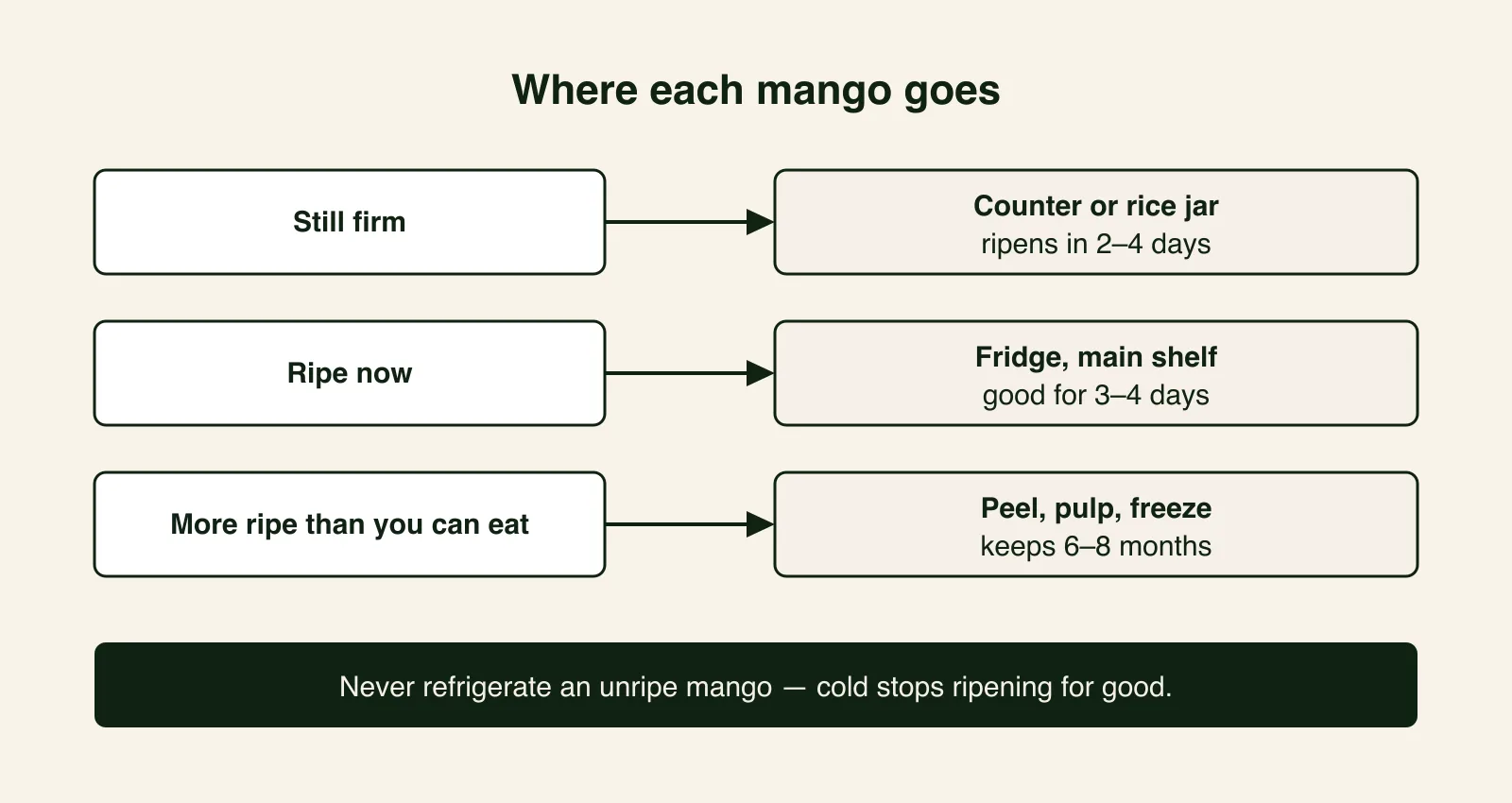
Keep firm Kesar mangoes on the counter at room temperature, in a single layer, out of direct sunlight, and they will ripen in two to four days — five at the outside. To hurry one along by about a day, sit it in a jar of rice, a bed of hay or a closed paper bag, all of which trap the ethylene gas the fruit releases. Never refrigerate a mango before it is ripe; cold interrupts ripening permanently. A ripe Kesar tells you three ways: a sweet smell at the stem end, a slight give under the thumb, and skin shading from green-gold toward saffron.
Why your box arrives firm, and why that is the good outcome
Mangoes are climacteric fruit — they continue ripening after harvest, driven by their own ethylene. That biology is what makes farm-direct delivery possible at all. Fruit picked at full maturity but still firm travels across India without bruising, then completes its ripening in your kitchen, where nothing gets stacked on it.
Consider what the alternative would look like. A box of soft, ready-to-eat mangoes shipped a long distance arrives bruised wherever each fruit pressed against its neighbour. So when any seller promises "ripe on delivery" across the country, the fruit was either picked long ago, treated to look ready, or is a day from overripe — our guide to spotting carbide-ripened mangoes explains that trade in detail. Firmness on arrival is the signature of honestly shipped fruit, which is why we tell every customer to expect it.
Day 0 — the first hour after delivery
Open the box the day it arrives. Ripening fruit generates its own heat, and a closed box concentrates heat and moisture. Take every mango out, check each one, and lay them in a single layer on a tray or a newspaper-lined shelf. Stacking creates pressure spots, and plastic bags trap moisture against the skin, so use neither.
Then sort. Any fruit that already smells sweet at the stem and yields slightly is ahead of the others — eat those first, or move them to the fridge once fully ripe. The firm majority stays on the counter.
Why do fruits ripen fast when kept in rice?
The rice jar, the hay bed and the paper bag are the same method in three forms. A ripening mango releases ethylene. In open air the gas disperses; in a semi-closed space it accumulates around the fruit and accelerates ripening. Rice does nothing chemically — the grain is simply an excellent gas trap that also cushions the fruit. Hay is the traditional version of the same trick, used in Indian homes and mandis for generations because it insulates gently while holding the gas in. A loosely closed paper bag is the mildest of the three.
Expect to save around a day, sometimes two if several mangoes share the space, since more fruit means more ethylene. The cost is attention: a mango buried in rice is invisible, easy to forget, and can slide past ripe before you check. Smell it daily. If nothing is forcing the pace, the open counter is the calmer method, because you can see every fruit.
How do you identify a ripe Kesar mango?
Smell first. Aroma at the stem end is the most reliable cue there is, because fragrance compounds only appear at the end of true ripening — a Kesar that smells sweet at the stem is ready, whatever the skin says.
Second, press gently with the flat of your thumb. Ripe flesh gives slightly, about like a ripe avocado. Use the flat of the thumb rather than a fingertip, which bruises.
Colour comes last because it misleads. Kesar deepens from green-gold toward saffron as it ripens, but a fully ripe Kesar can still hold green on its skin. Waiting for uniform yellow is how good fruit slips past its peak — and in a market, a perfectly uniform yellow can mean something worse than impatience.
When the fridge helps and when it ruins the fruit
Once a mango is ripe, the fridge is your friend: main compartment, and you get three to four more days of good eating. Take the fruit out twenty or thirty minutes before serving — cold mutes the aroma compounds, and a Kesar eaten straight from the fridge tastes flatter than the same fruit at room temperature.
Before a mango is ripe, the fridge is where flavour goes to die. Below roughly 10 °C the ripening enzymes shut down and do not restart properly — horticulturists call it chilling injury. A refrigerated unripe mango may eventually soften, but the sugar and aroma never finish developing, and the flesh can turn greyish near the skin. So the answer to "can I refrigerate unripe mangoes" is no: refrigeration is where ripening ends, so use it only once ripening is finished.
Too many ripe at once
Whole mangoes freeze badly — ice crystals rupture the flesh, and what thaws is mush. Pulp freezes very well. Peel, cube or blend, pack into an airtight container with as little air as possible, and freeze: it keeps six to eight months, which carries Kesar aamras deep into the off-season. If a large box ripens faster than the family can eat, a pulping session on day four or five is the plan, and it takes about ten minutes per kilo.
Troubleshooting the odd cases
One soft spot on one fruit: eat that mango today and cut around the spot; the rest of the flesh is fine.
The box is ripening unevenly: normal. Fruit from the same harvest differs by where each mango hung on the tree and how much sun it saw, so a spread of two or three days across a box is expected. Give the stragglers time.
A week and still hard: almost always a cool room. Air-conditioned rooms sit below the temperature ripening likes, and fruit in them can stall for days. Move the mangoes to the warmest corner of the kitchen, or use the rice jar. If a mango is genuinely unripe after ten days, something went wrong on our side — message us; a person answers, and we make it right.
If you are planning your next order rather than rescuing this one, our Kesar season guide covers when each window of the season is worth ordering into.
FAQ
Questions readers often ask
Keep Reading
More stories from the orchard

Kesar vs Alphonso — Which Mango Should You Buy?
Both are elite mangoes. Alphonso brings buttery dessert richness at ₹1,000-plus per kg online; Kesar brings saffron aroma and a sweet-tang balance at a third of the price. Here is how to choose.
Abhilash Kasliwal
6 min read

How to Tell if a Mango Was Ripened with Carbide — 5 Home Tests
Five checks — water, skin, stem, cut and taste — that catch most carbide-ripened mangoes, what each one can and cannot prove, and why the difference exists at all.
Abhilash Kasliwal
7 min read

Is It Safe to Order Mangoes Online in India? A Farmer's Honest Checklist
Yes, if you check five things before paying. A farmer's checklist for spotting honest mango sellers — named farms, firm-fruit honesty, stated weights, a real damage policy and season discipline.
Abhilash Kasliwal
6 min read