
When Is Kesar Mango Season? A Month-by-Month Guide

Abhilash Kasliwal
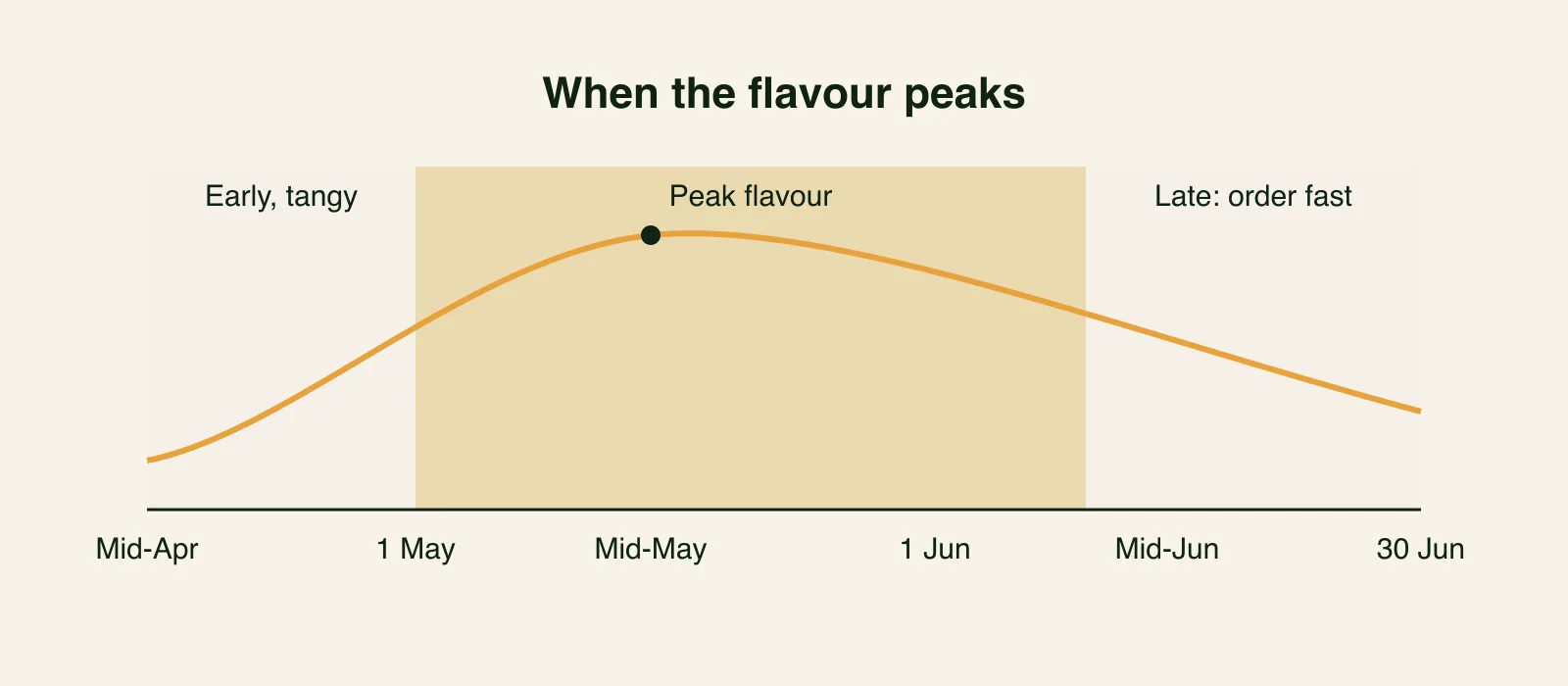
Kesar mango season runs from mid-April to late June, and flavour peaks around mid-May. For the best fruit of the year, order in the first half of May. Late April brings the season's first boxes — slightly firmer and a shade tangier — while June brings the last batches, where ordering early in the month matters because pre-monsoon weather can close the season ahead of the calendar.
The Kesar year, month by month
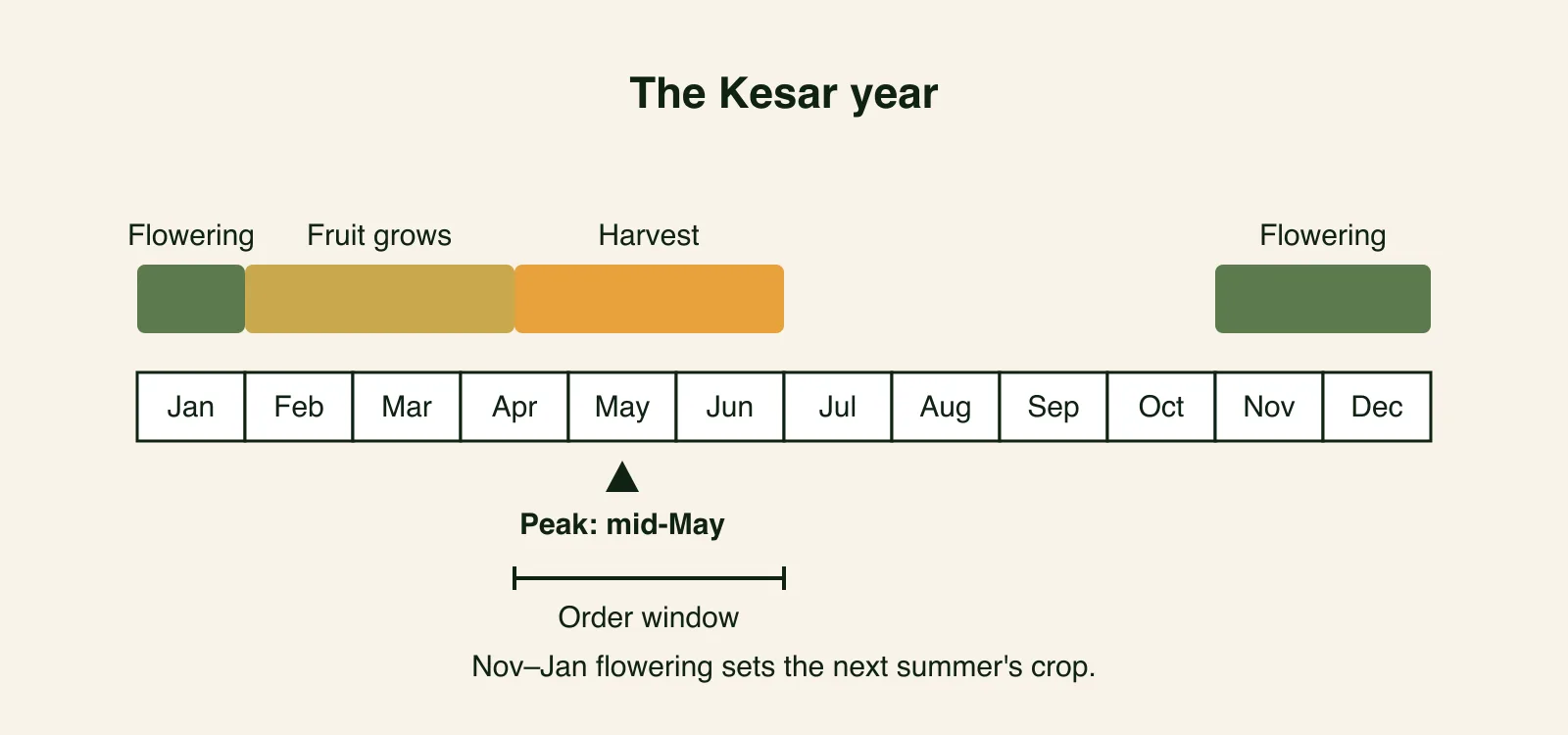
The two and a half months you can eat a Kesar are set up by the nine months before them. The trees flower between November and January. Fruit sets in the weeks after, and from February to April the young mangoes size up through Marathwada's hot, dry spring — the Deccan climate the variety thrives in. Then the harvest window opens.
Mid to late April — the first harvests. The fruit is firm, the tang is brighter, and the aroma is a step lighter than it will be. Some customers wait all year specifically for this early character.
May — the peak. Sugars are fully developed, the saffron aroma is at its widest, and supply is steadiest. If you order once a season, this is the month.
June — the last batches. Early June is still excellent. As the monsoon approaches, humidity rises, storms interrupt harvest days, and supply becomes batch-by-batch until the season ends.
There is no Kesar in March, anywhere. A seller offering it that early deserves suspicion — and if you want a premium mango that month, Alphonso is the one genuinely in season.
Why the season shifts by weeks from year to year
The window is set by weather that happened months earlier. Flowering between November and January is the sensitive stage: unseasonal rain or long stretches of fog during those weeks hurt fruit set, a cold late winter pushes everything back, and a hot March pulls maturity forward. Marathwada also sees pre-monsoon hailstorms in some years, and a bad one can take fruit off trees in an afternoon. The practical effect is a window that moves by up to two weeks in either direction — the "mid-April" in every guide, including this one, is an average.
Harvest day itself is decided on the fruit, never on the calendar. Maturity shows in ways a grower learns to read: the shoulders of the fruit fill and round out, the skin loses its green gloss, and a sample fruit cut open shows flesh turning from cream toward yellow at the seed. When a block of trees shows those signs, it gets harvested. "Picked only when ready" is not a slogan on our boxes so much as a weekly scheduling decision, made tree block by tree block.
What Kesar costs through the season
Wholesale prices follow a predictable shape: an early-season premium while fruit is scarce, the best value at peak when supply is fullest, and erratic pricing late as supply swings batch to batch. For scale, market reports from June 2026 put premium Kesar at ₹167 per kg at Pune's Market Yard — a five-year high for the wholesale market.
Farm-direct pricing works differently. Our Kesar is ₹300 per kg through the season, and the gap over the mandi number is the whole journey the mandi price leaves out: grading every fruit, organic certification, packing by hand, and a courier to your door, with no middlemen taking a margin in between. Whether that trade is worth it is a fair question to ask of any farm — our guide to ordering mangoes online sets out how to judge a seller, us included.
How batch harvesting changes when your box ships
A cold-storage supply chain ships the day you order, because the fruit is already sitting in a warehouse. A family farm ships when the trees are ready: we harvest a block at maturity, grade the fruit the same day, and our family packs the boxes for the orders in queue before dispatch. Depending on where your order lands relative to a harvest day, your box may ship a few days after you order, and a storm can move a harvest day.
The honest trade-off: if you need mangoes tomorrow, a local shop wins. What batch dispatch buys you is fruit that was hanging on a tree the same week it entered a courier bag — which is the entire point of ordering from a farm, and why the harvest sets the schedule.
The best time to order, window by window
Late April — for the early-season character: firmer, tangier, first of the year.
First half of May — the peak. The fruit is at its best and supply is steadiest.
Early June — the last full-flavoured window; order in the first week.
Late June — ask us first. Some years the fruit holds; some years we decline orders because what remains is below the season's standard, and we would rather decline than ship it.
What to do the other nine months
From July to March there is no fresh Kesar, and anyone claiming otherwise is selling something else. Two things bridge the gap. Frozen pulp from a May box keeps six to eight months in the freezer — our ripening and storage guide covers how to pulp and freeze it properly — which puts real Kesar aamras on the table at Diwali. And a message to us at any time of year gets you noted down for the season-open announcement, sent the same personal way we handle order updates, so you hear when the first harvest is graded rather than when a marketing calendar says so.
FAQ
Questions readers often ask
Keep Reading
More stories from the orchard

Kesar vs Alphonso — Which Mango Should You Buy?
Both are elite mangoes. Alphonso brings buttery dessert richness at ₹1,000-plus per kg online; Kesar brings saffron aroma and a sweet-tang balance at a third of the price. Here is how to choose.
Abhilash Kasliwal
6 min read
How to Tell if a Mango Was Ripened with Carbide — 5 Home Tests
Five checks — water, skin, stem, cut and taste — that catch most carbide-ripened mangoes, what each one can and cannot prove, and why the difference exists at all.
Abhilash Kasliwal
7 min read
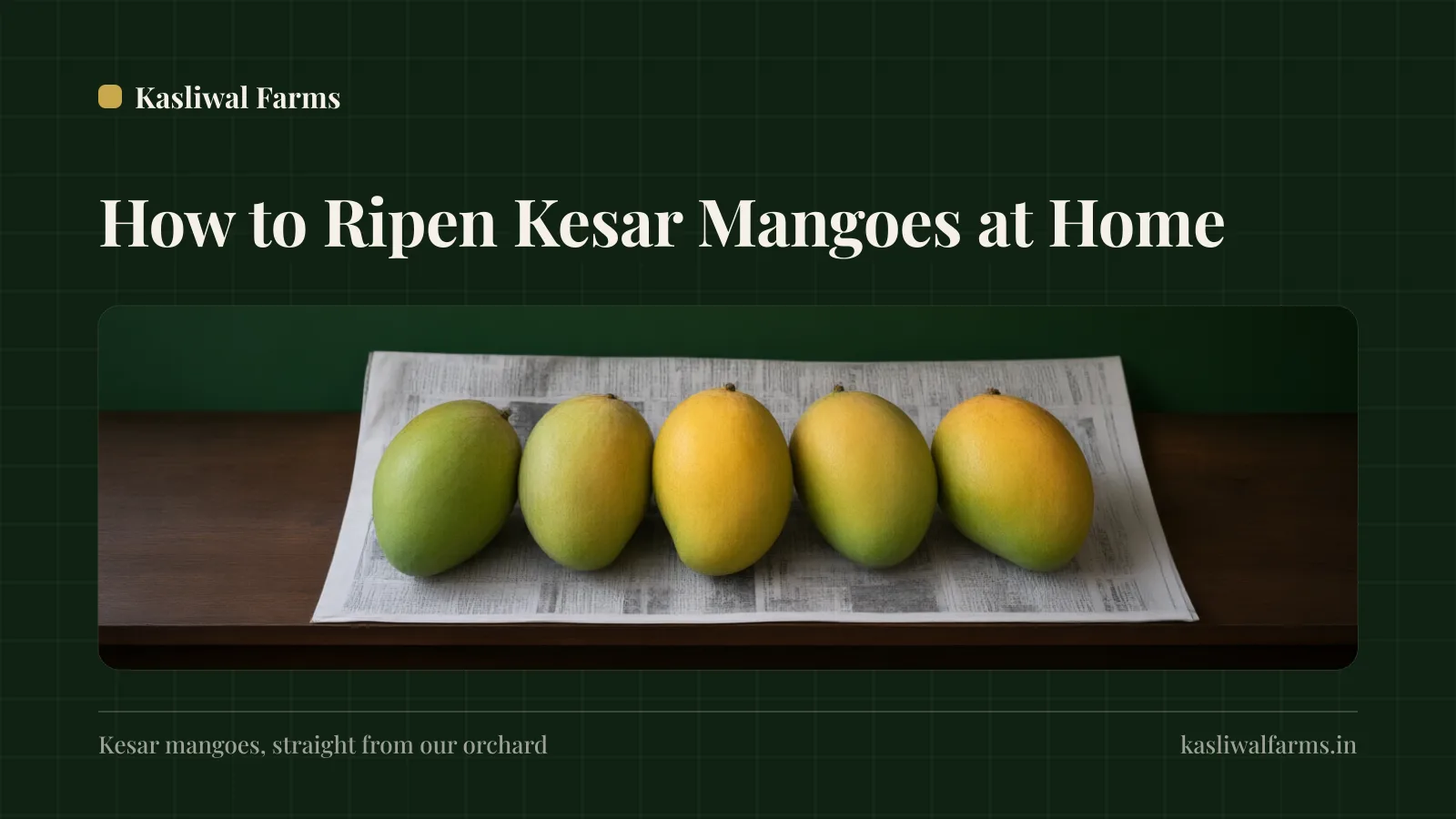
How to Ripen Kesar Mangoes at Home — A Day-by-Day Guide
Firm Kesar mangoes ripen on the counter in 2–4 days. When the rice jar helps, when the fridge ruins fruit, and how to tell a Kesar is ready by smell, give and colour.
Abhilash Kasliwal
6 min read