
Can Diabetics Eat Kesar Mangoes? Sugar, Portions and the Honest Answer

Abhilash Kasliwal

Yes, most people managing diabetes can eat Kesar mango in moderation: a portion of around 100 g of flesh at a time, eaten whole rather than juiced, ideally alongside protein or nuts, and counted within the day's carbohydrate budget rather than added on top of it. Mango is not a forbidden food, and it is not a free one either; it is a carbohydrate that has to be planned like any other. Before acting on any of this, one thing must be said plainly: this article is general nutrition information, not medical advice, and the right portion for you should be confirmed with your doctor or dietician.
What is actually in a Kesar
Per 100 g of flesh, mango carries roughly 60 calories, 15 g of carbohydrate of which about 13.7 g is sugar, and 1.6 g of fibre, going by USDA food data. It also delivers meaningful vitamin C and vitamin A, which is part of why the fruit earns a place in a diet at all rather than being an indulgence to apologise for.
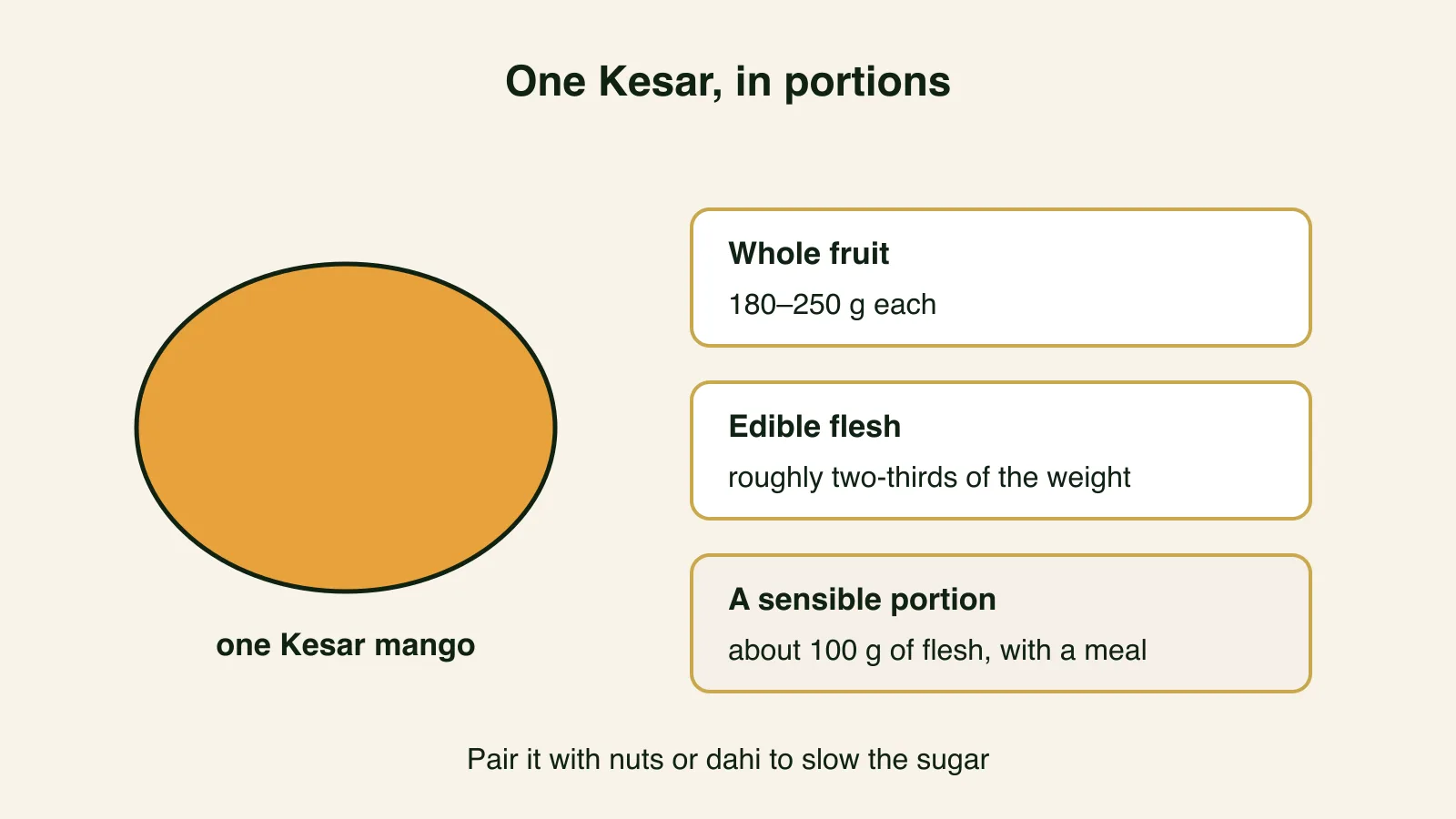
A Kesar fruit weighs 180 to 250 g whole, and after the peel and stone are set aside, roughly two-thirds of that is flesh. So one typical fruit yields around 130 to 160 g of edible mango, and a 100 g portion is about two-thirds of one fruit. This arithmetic matters more than any other number in this article, because almost nobody eats "100 g of mango" by instinct. In season, sitting with a full box, people eat two or three fruits without noticing. That, and not the mango itself, is where diabetic meal plans come apart.
Does eating ripe mangoes increase blood sugar levels?
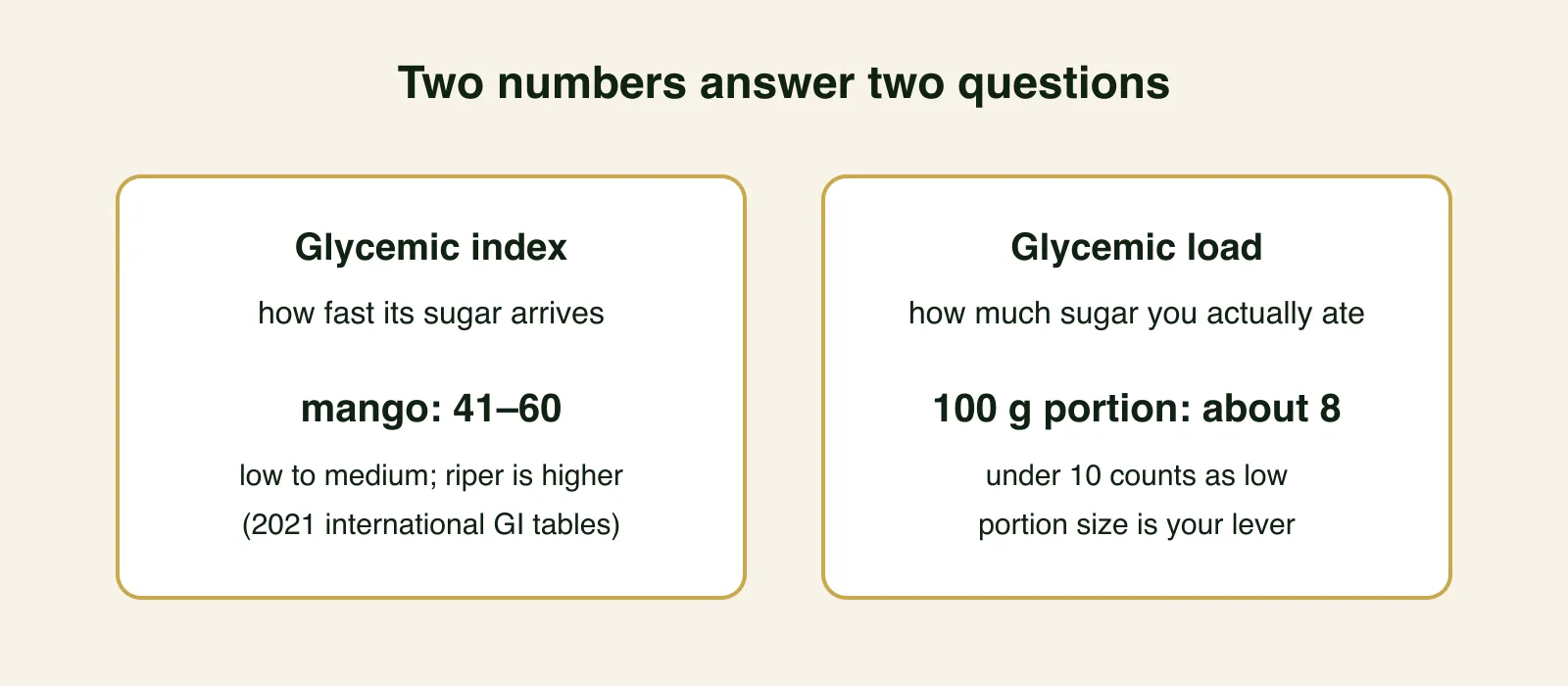
Yes, the way any carbohydrate does; the useful questions are how fast and how much. Speed is what the glycemic index (GI) measures, and mango does better here than its sweetness suggests. Published measurements collected in the international GI tables put raw mango between 41 and about 51 depending on variety, with ripe Indian mango measured around 60. That is a low-to-medium GI, in the same broad band as many fruits. The mechanism is fructose: a large share of mango's sugar is fructose, which raises blood glucose more slowly than glucose does, and the fruit's fibre slows absorption further.
Notice what the range is telling you, though. Riper fruit measures higher, because ripening converts the fruit's starch into sugar. A fully ripe, meltingly soft mango is a genuinely sweeter fruit than a firm one, so a diabetic eating at peak ripeness should hold the portion line rather than reason that mango is a low-GI food and relax.
Glycemic index vs glycemic load, in plain words
GI tells you how quickly a food's carbohydrate arrives in the blood. It says nothing about quantity, and quantity is what you actually control at the table. Glycemic load (GL) combines both: multiply the GI by the grams of carbohydrate in your portion and divide by 100.
Run the numbers for the portion we suggested. A 100 g serving of mango flesh carries about 15 g of carbohydrate. Take a cautious GI of 55, and the load is 55 × 15 ÷ 100, which is about 8. Under 10 is conventionally counted as a low glycemic load. Eat the whole fruit and you have doubled it into the medium band; eat three fruits over an afternoon and the mango is now doing what people fear mango does. Same fruit in every case. The portion is the variable, which is genuinely good news, because portions are within your control and the fruit's chemistry is not.
Swap, don't stack
The most practical rule we know for fitting mango into a diabetic meal plan is this: mango replaces another carbohydrate in the meal, it does not join it. If mango follows a full lunch of rice and chapati, the load stacks. If a smaller helping of rice makes room for the fruit, the day's total stays where the plan put it. Eating the portion with a meal, or with protein and fat such as nuts or dahi, also flattens the spike, because fat and protein slow how quickly the stomach empties.
For healthy adults without diabetes, the daily-mango question is easier: a fruit a day through a nine-week season is a perfectly reasonable habit, and at about 60 calories per 100 g, mango is a modest snack by any standard. The people who gain weight in mango season mostly do it through milkshakes and overeating, which brings us to the delivery mechanism.
Whole fruit beats juice, every time
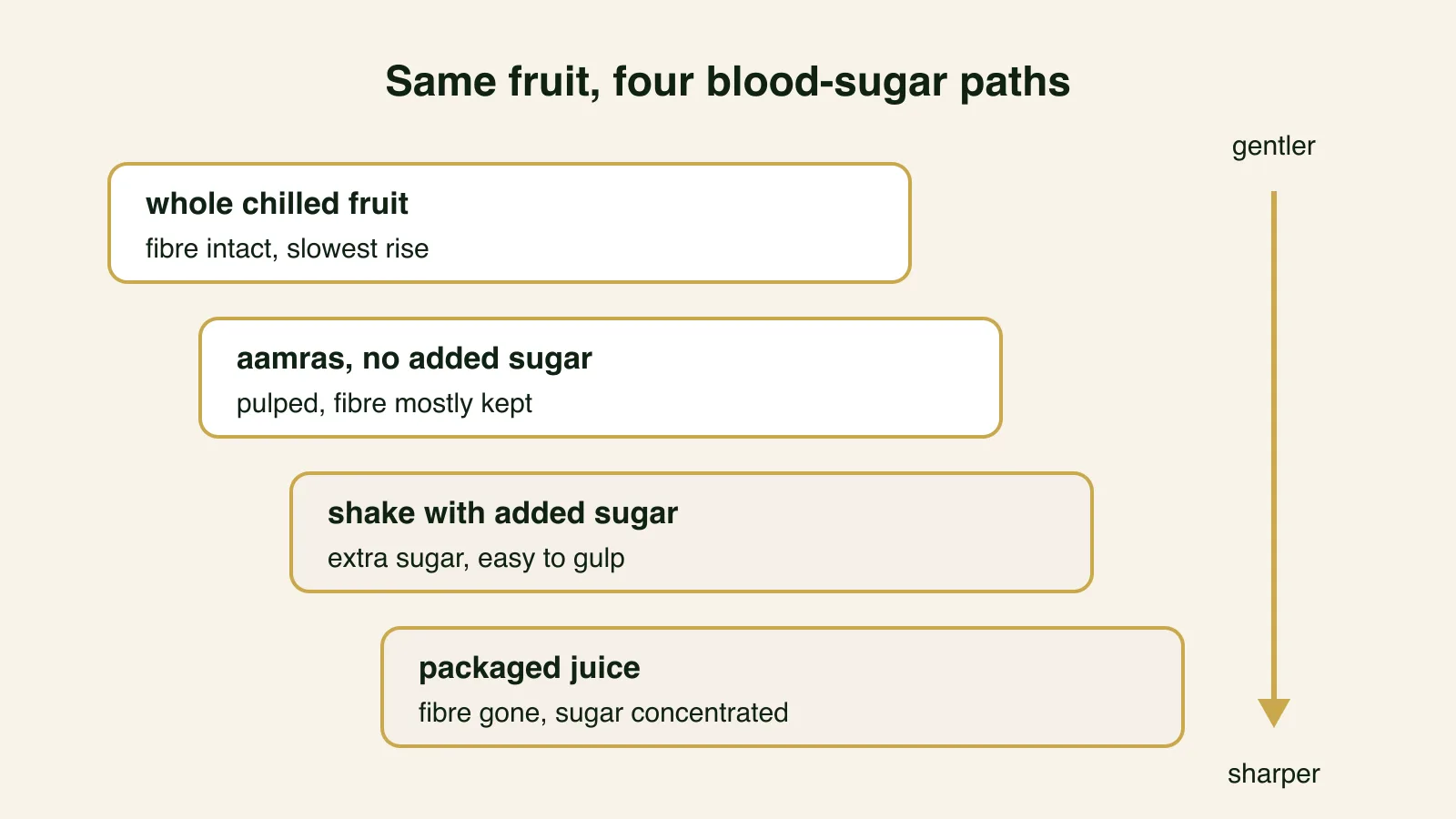
How you eat the mango changes what it does to your blood sugar, and the ordering is consistent. Whole fruit is best: the intact fibre slows digestion and the chewing slows you. Aamras without added sugar comes close, since pulping breaks some structure but keeps the fibre in the bowl; our family recipe adds nothing anyway, as we describe in what to do with 5 kg of Kesar mangoes. A shake adds sugar and milk and goes down in minutes. Packaged juice is the worst case: fibre removed, sugar concentrated, drunk fast, with none of the fullness that whole fruit brings. A diabetic who loves mango should spend their carbohydrate budget on the fruit itself, chilled, and skip the liquid forms.
One last honest note on sweetness. A tree-ripened Kesar tastes dramatically sweeter than its sugar numbers alone explain, because ripening builds the aroma compounds that amplify perceived sweetness. This is a reason naturally ripened fruit satisfies at smaller portions: you get the full flavour experience from 100 g instead of chasing it through 300. We would say that, of course, being the people who grow it, but the mechanism is real and works in a careful eater's favour.
This is general nutrition information, not medical advice. If you have diabetes, confirm portion sizes with your doctor or dietician before making mango a routine.
FAQ
Questions readers often ask
Keep Reading
More stories from the orchard

Kesar vs Alphonso — Which Mango Should You Buy?
Both are elite mangoes. Alphonso brings buttery dessert richness at ₹1,000-plus per kg online; Kesar brings saffron aroma and a sweet-tang balance at a third of the price. Here is how to choose.
Abhilash Kasliwal
6 min read

How to Tell if a Mango Was Ripened with Carbide — 5 Home Tests
Five checks — water, skin, stem, cut and taste — that catch most carbide-ripened mangoes, what each one can and cannot prove, and why the difference exists at all.
Abhilash Kasliwal
7 min read

How to Ripen Kesar Mangoes at Home — A Day-by-Day Guide
Firm Kesar mangoes ripen on the counter in 2–4 days. When the rice jar helps, when the fridge ruins fruit, and how to tell a Kesar is ready by smell, give and colour.
Abhilash Kasliwal
6 min read