
Gir Kesar vs Marathwada Kesar: The Two Homes of India's Saffron Mango

Abhilash Kasliwal

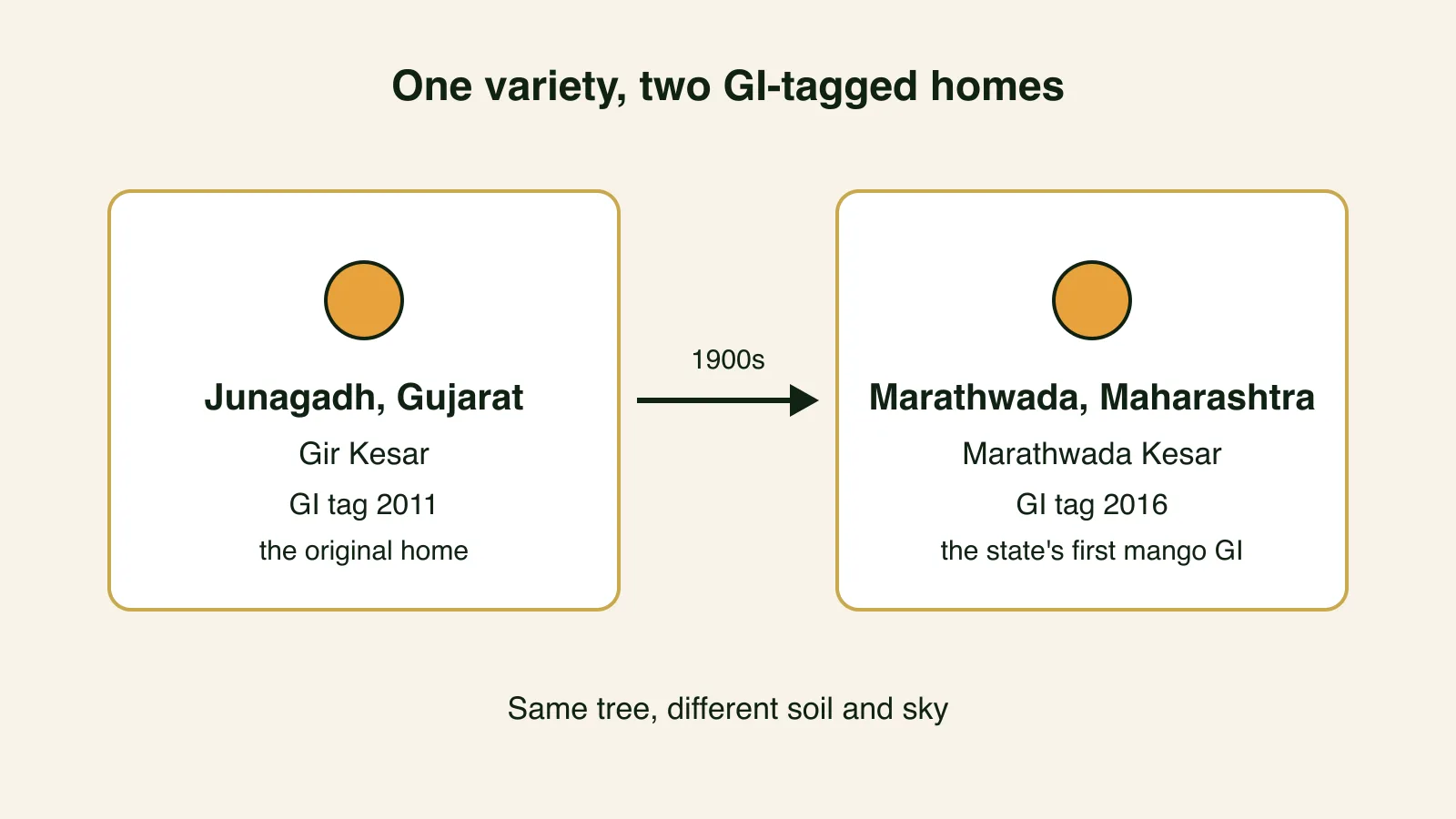
Gir Kesar and Marathwada Kesar are the same mango variety grown in two different regions, and each region holds its own Geographical Indication (GI) tag: Gir Kesar was registered in 2011 for the Junagadh belt of Gujarat, and Marathwada Kesar in 2016, the first GI tag any mango from Maharashtra has received. The tree's genetics are identical in both places; the climate and soil are not, and that is what separates the two fruits. Our family has grown Kesar in Marathwada for over forty years, so read what follows knowing where we stand. The facts hold either way.
One mango, two GI-tagged homes
Most famous Indian mangoes have one legal home. Alphonso belongs to the Konkan coast, Banganapalli to Andhra. Kesar is unusual because the law recognises two: the orchards around Girnar hill in Gujarat's Junagadh district, and the Marathwada region of Maharashtra, where the variety has been grown long enough and distinctly enough to earn its own registration in 2016.
That second tag matters more than it sounds. A GI tag is not handed out for growing someone else's variety well. The registrar has to accept that the place itself produces a version of the fruit with its own character. Marathwada's application succeeded on exactly that ground, and the quality it is best known for is sugar: Marathwada Kesar records among the highest soluble-solids content of any Indian mango. Soluble solids are how sweetness is measured in fruit, the dissolved sugars in the juice, so this is a measurable claim rather than regional pride.
Why is a Gujarati mango called Kesar?
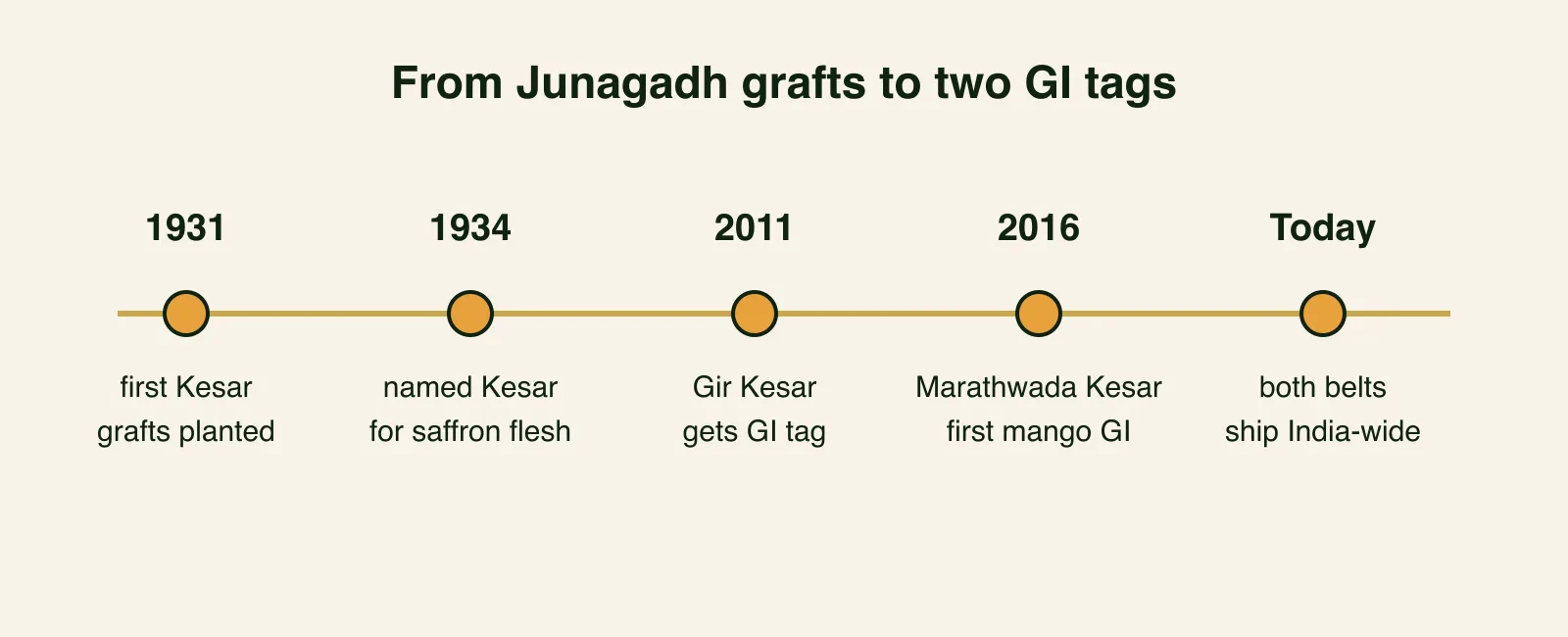
The first grafts of what became Kesar were planted near Junagadh in 1931. In 1934, the story goes, the Nawab of Junagadh saw the cut fruit's deep orange flesh and named it for what it resembled: kesar, the Hindi word for saffron. The name stuck because it describes the fruit precisely. A ripe Kesar's flesh is the colour of saffron-infused milk, and its aroma leans the same way, sweet with a faint spice to it.
How Kesar reached Marathwada
Good varieties travel the way good recipes do: a farmer tastes something remarkable, gets hold of graftwood, and plants it at home. Over the following decades Kesar grafts moved east into the Deccan interior, and Marathwada turned out to suit the variety unusually well.
The two belts share the variety's calendar as well as its genes. Marathwada's harvest runs mid-April to late June, opening with smaller, firmer fruit and peaking in May, when the trees have had the full benefit of the dry heat.
The reason it thrives here is mostly water, or the lack of it. Mango trees flower best after a dry, mild winter, and fungal diseases that ruin blossoms thrive in humidity. Marathwada is one of India's drier regions, which is hard on the farmer but useful for the tree: clean flowering, fewer disease pressures, and fruit that ripens under intense dry heat. A tree given less water also tends to set slightly smaller fruit with more concentrated sugars, which is the most likely explanation for Marathwada Kesar's exceptional soluble-solids readings. The dryness that makes farming here difficult is the same dryness that makes the fruit sweet.
What a GI tag protects, in plain words
A Geographical Indication is a legal link between a product's name and its place. Once registered, only producers inside the mapped region, who have registered as users of the tag, may sell their produce under that name. Darjeeling tea works this way; so does Champagne. The point is to stop a name that a region built over generations from being borrowed by anyone with a printing press and a sticker roll.
Earning a tag is slower than it sounds. A growers' body must map the region's boundaries, document the history of cultivation there, and satisfy the registrar that the place produces something with an identity of its own. That is why the 2016 registration mattered beyond the paperwork: it put on record that Marathwada's Kesar is a fruit with its own documented character, rather than Gujarat's crop on borrowed soil.
It is worth being clear about what the tag does not do. It does not grade the box in front of you. A GI-region mango can still be picked too early, ripened with calcium carbide, or handled badly in transit. The tag answers "where is this from" and nothing else. Whether a particular box is good depends on the orchard, the harvest timing, and how it was ripened, which is why we would tell you to ask a seller how the fruit was ripened before asking which district it came from.
So which one tastes better?
Here is the honest answer: the differences between two orchards inside the same region, the soil, the harvest week, the ripening method, are often larger than the average difference between the regions. A well-grown, tree-matured, naturally ripened Kesar from either belt is a fruit you will remember.
That said, the regions do lean different ways. Marathwada's measured edge is sweetness, the soluble-solids record mentioned above, and its fruit ripens under some of the driest heat in the country. Gir has the depth of the original home: nine decades of cultivation around Girnar and the name's whole history. Both share the things that make Kesar recognisable anywhere, the saffron flesh, the low fibre, and the balance of sugar against a faint tang that keeps aamras from tasting flat.
There is also a variable that outweighs geography entirely: what happened between tree and table. A Kesar picked at full maturity and ripened naturally over several days converts its starch completely and builds its full aroma. A Kesar picked early and ripened with calcium carbide in two days gets the colour without the chemistry, whichever GI region it came from. Put a naturally ripened fruit from either belt next to an artificially ripened one from the "better" region and the region loses. So our advice, even as Marathwada growers, is to choose your ripening method first and your region second.
| Gir Kesar | Marathwada Kesar |
|---|---|---|
State | Gujarat | Maharashtra |
GI tag year | 2011 | 2016 |
Landscape | Girnar foothills | dry Deccan plateau |
Known for | the original home since 1934 | among the highest sugar content |
Where our family fits in this story
Dr Pravin Kasliwal planted our first Kesar trees in Marathwada more than forty years ago, and two generations of the family have worked the orchard since. We grow only Kesar, farm it organically, and never touch calcium carbide; every fruit ripens naturally and every box is packed by the family. The season runs mid-April to late June, and we ship across India at ₹300 a kilo.
If you have never eaten a Marathwada Kesar, the sensible first step is a 1 kg trial box, which holds four to six fruits. We explain the counts, sizes and box options in how many Kesar mangoes are in 1 kg, and what a bigger box turns into over a week in what to do with 5 kg of Kesar mangoes.
FAQ
Questions readers often ask
Keep Reading
More stories from the orchard
Kesar vs Alphonso — Which Mango Should You Buy?
Both are elite mangoes. Alphonso brings buttery dessert richness at ₹1,000-plus per kg online; Kesar brings saffron aroma and a sweet-tang balance at a third of the price. Here is how to choose.
Abhilash Kasliwal
6 min read
How to Tell if a Mango Was Ripened with Carbide — 5 Home Tests
Five checks — water, skin, stem, cut and taste — that catch most carbide-ripened mangoes, what each one can and cannot prove, and why the difference exists at all.
Abhilash Kasliwal
7 min read
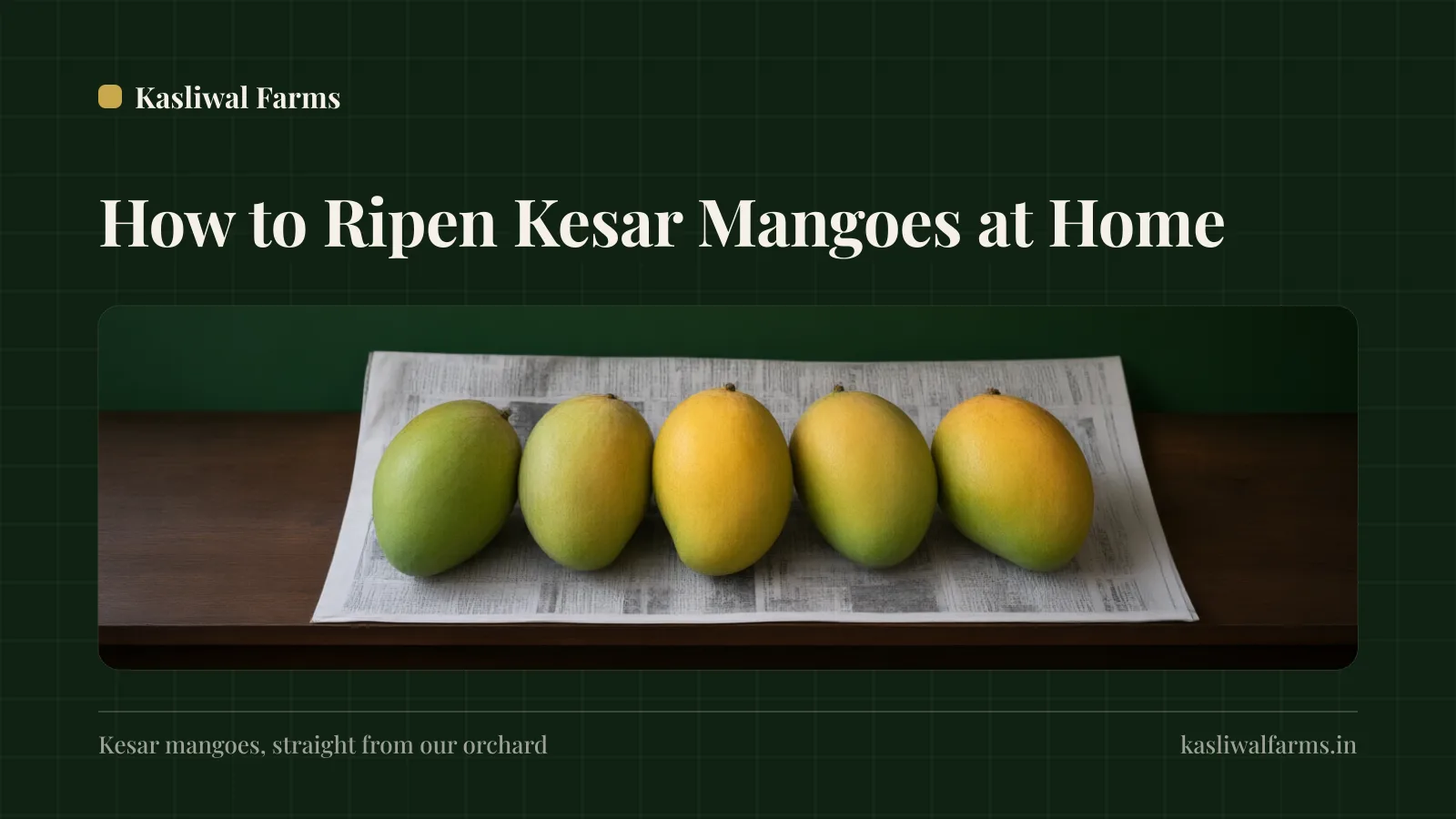
How to Ripen Kesar Mangoes at Home — A Day-by-Day Guide
Firm Kesar mangoes ripen on the counter in 2–4 days. When the rice jar helps, when the fridge ruins fruit, and how to tell a Kesar is ready by smell, give and colour.
Abhilash Kasliwal
6 min read