
How Many Kesar Mangoes Are in 1 Kg? Box Sizes, Weights and What They Cost

Abhilash Kasliwal

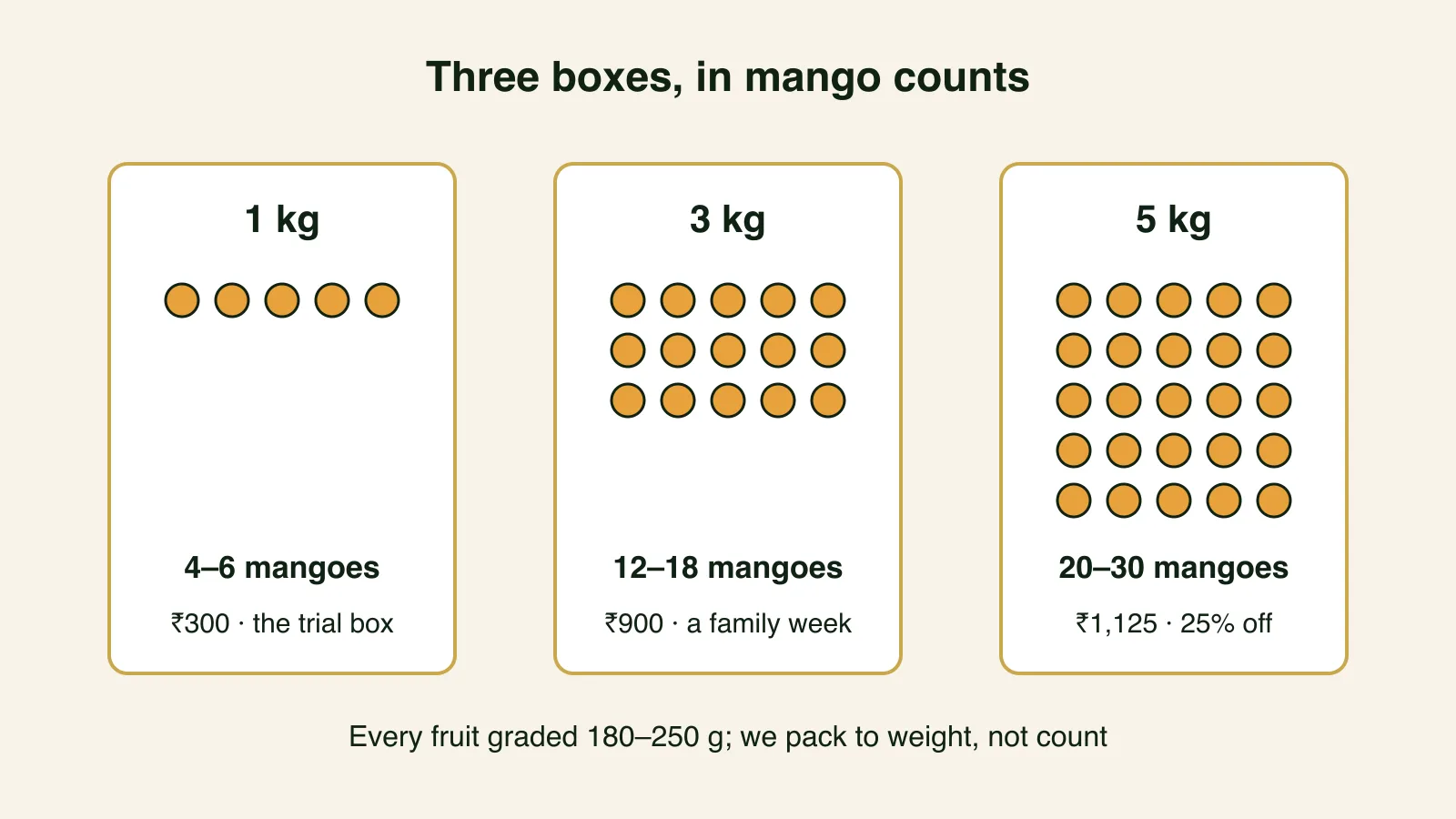
A Kesar mango weighs 180 to 250 g, so 1 kg holds 4 to 6 fruits; five is the most common count from our orchard in mid-season. Early-season fruit runs smaller and pushes the count toward six, while peak-season fruit is larger and closer to four. We sell by weight, never by dozen, at ₹300 a kilo in boxes from 1 to 10 kg, with 25% off at 5 kg.
What changes the count
Two things, and neither is a trick. The first is the calendar: mangoes picked in the season's opening weeks have had less time on the tree and weigh less, so an April kilo may hold six fruits where a late-May kilo holds four. The second is that a tree simply does not produce identical fruit, even from the same branch. We grade to the 180–250 g band and pack to weight, so the count inside your box floats within that honest range while the kilos stay exact. If a seller promises a fixed count and a fixed weight at the same time, one of those numbers is being managed, and it is usually the weight.
Which box fits your household
The box sizes exist because households come in sizes. One kilo is the trial box: four to six fruits, enough for every member of a small family to eat Kesar properly ripened over a few days and decide whether the fruit deserves a bigger order. Three kilos suits a family that wants fruit on the table for most of a week. Five kilos is the box for families who eat mango daily and want aamras in the plan, and it carries the 25% discount, ₹1,125 instead of ₹1,500, because a bigger box costs us proportionally less to pack and ship. Boxes go up to 10 kg for joint families, or for two households splitting an order.
Box | Mango count | Suits | Price |
|---|---|---|---|
1 kg | 4–6 | first-time trial | ₹300 |
3 kg | 12–18 | a family's week | ₹900 |
5 kg | 20–30 | daily fruit plus aamras | ₹1,125 (25% off) |
Why we sell by weight and not by dozen
A dozen is a count, and a count hides size. Twelve small mangoes and twelve large ones are both "a dozen", but they can differ by a kilo of actual fruit, which is why dozen-sellers so often photograph large fruit and ship small. Weight closes that gap: put your delivered box on a kitchen scale and you know within seconds whether you got what you paid for. We would rather sell by a number you can check at your doorstep than by one you cannot.
Why ₹300 when the mandi record was ₹167?
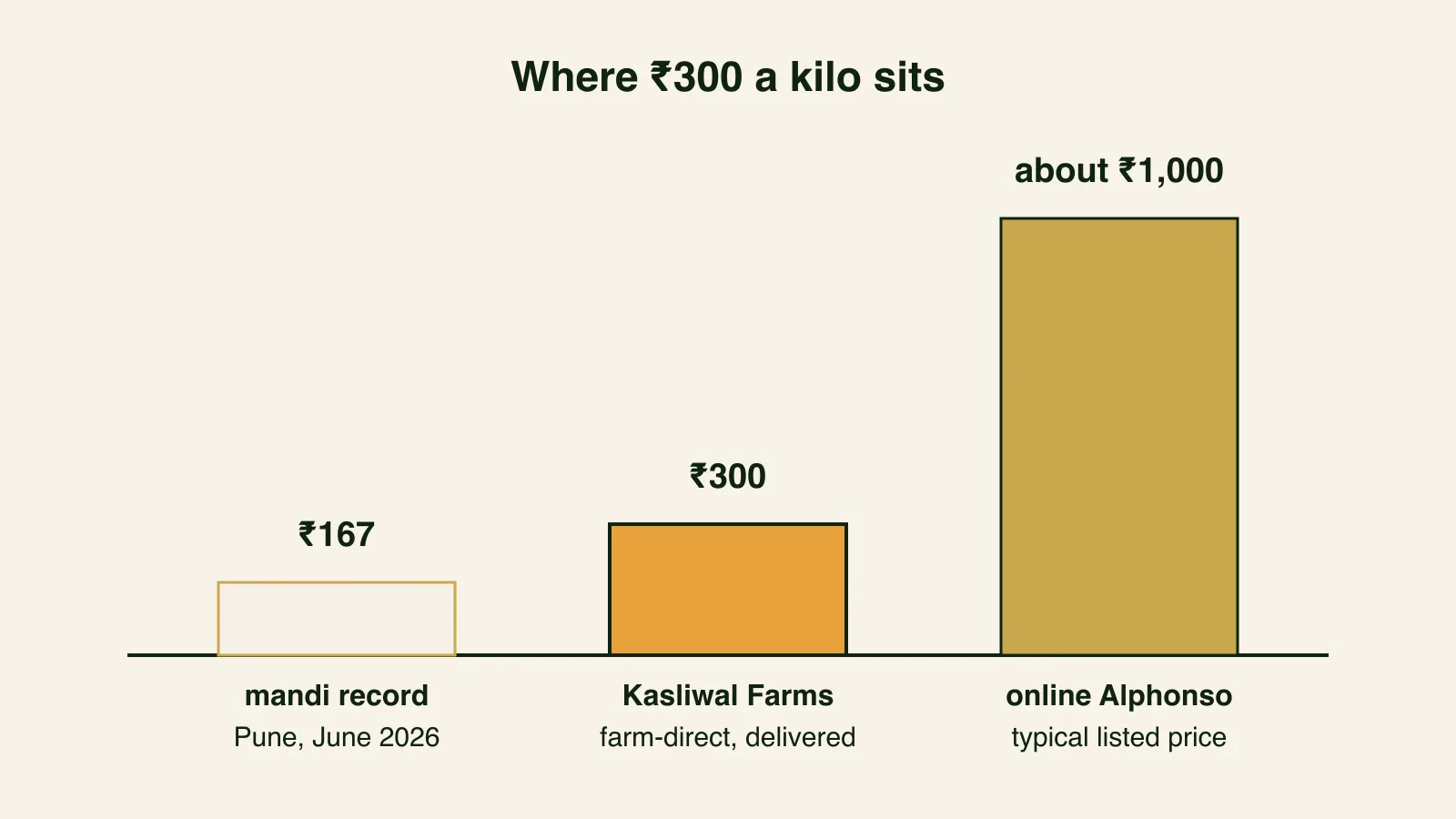
Price context, with sources: premium Kesar touched ₹167 a kilo at Pune's Market Yard in June 2026, a mandi record, while Alphonso sold online typically runs near ₹1,000 a kilo. Our ₹300 sits between those numbers, and it is fair to ask why it is above the mandi.
The mandi price is a wholesale price for loose crates at the yard: ungraded sizes, unknown ripening ahead of it, and the fruit still a middleman and a retail margin away from your kitchen. Our ₹300 is a delivered price, and the difference buys specific things: grading so every fruit sits in the 180–250 g band, organic cultivation, natural ripening with zero carbide, packing done by our own family, and courier to your door anywhere in India with no middle layers taking a cut on the way. If you live near a good mandi, can grade fruit yourself, and are confident about how it was ripened, mandi fruit is genuinely cheaper and we will not pretend otherwise. What you pay us for is selection, certainty about ripening, and delivery.
How much aamras does 1 kg make?
Plan on roughly 600 g of pulp from a kilo of whole fruit, since the peel and stone claim about a third of the weight. That is three to four proper bowls of aamras, which means a 1 kg box makes one aamras lunch for a small family and a 5 kg box can cover fresh eating all week and still leave two kilos for pulping. The full week-by-week plan, including freezing pulp for the off-season, is in what to do with 5 kg of Kesar mangoes.
The storage math for a bigger box
A 5 kg box is 20 to 30 fruits, which sounds like a lot until you watch a family eat in season. Four people eating two fruits a day clear ten kilos in under a week; even at one fruit each, a 5 kg box lasts roughly a week, which is comfortably inside Kesar's ripening-and-eating window when the fruit arrives firm and ripens in stages. If you are new to the variety, or new to us, start with the 1 kg trial and taste what Marathwada does to a Kesar; the background on why our region's fruit measures among India's sweetest is in Gir Kesar vs Marathwada Kesar.
FAQ
Questions readers often ask
Keep Reading
More stories from the orchard

Kesar vs Alphonso — Which Mango Should You Buy?
Both are elite mangoes. Alphonso brings buttery dessert richness at ₹1,000-plus per kg online; Kesar brings saffron aroma and a sweet-tang balance at a third of the price. Here is how to choose.
Abhilash Kasliwal
6 min read

How to Tell if a Mango Was Ripened with Carbide — 5 Home Tests
Five checks — water, skin, stem, cut and taste — that catch most carbide-ripened mangoes, what each one can and cannot prove, and why the difference exists at all.
Abhilash Kasliwal
7 min read

How to Ripen Kesar Mangoes at Home — A Day-by-Day Guide
Firm Kesar mangoes ripen on the counter in 2–4 days. When the rice jar helps, when the fridge ruins fruit, and how to tell a Kesar is ready by smell, give and colour.
Abhilash Kasliwal
6 min read